Monday, April 22, 2013

Happy Earth Day 2013 from Great Swamp Watershed Association!

istockphoto.com/pearleye
Earth Day 2013 is here! According to the Earth Day Network, more than a billion people in 192 countries are participating in related events around the globe.

Since this year's official observance falls on a Monday, most folks are probably spending the day at work. But, remember that April is often called "Earth Month" and this week is often called "Earth Week." Perhaps you marked Earth Day early at an event this past weekend or earlier in April.  Perhaps you're observing it in the days to come. When you get right down to it, any day is a good day for an Earth Day celebration!

Help GSWA keep this year's Earth Day spirit alive and kicking throughout May too! There are few ways you can help.

Volunteer

Why not become a GSWA volunteer?

There are two important volunteer opportunities coming up soon. On Sunday, May 5, Laura Kelm, our director of water quality programs, is looking for volunteers to help with our annual stream restoration project. This event, which is our version of a traditional Earth Day cleanup, will take place at Kitchell Pond in the heart of Morris County's Loantaka Brook Reservation. We will be building a new vegetated buffer around the pond that will work to curb the negative effects of  stormwater runnoff and erosion. Much of the work will center around planting native shrubs and plants that slow down stormwater flow and help absorb water into the ground. For more information about this event, visit https://greatswamp.ejoinme.org/Sp13StreamRest.

Sunday, May 19 is your opportunity to become a member of GSWA's Stream Team at our biannual stream assessment training for volunteers. Held twice a year (once in the fall and once in the spring), GSWA's visual assessment training teaches volunteers how to observe and record important scientific data about our local stream reaches, including information like stream depth, stream width, and the presence or absence of streambank erosion. Trained Stream Team members are in short supply, so please help us out by coming to this event. For more information about this hands-on, indoor-outdoor workshop, visit https://greatswamp.ejoinme.org/Sp13StreamAssess.

Learn

Take some time to educate yourself on an important environmental topic: climate change.

The Face of Climate Change is the theme that Earth Day Network—an international nonprofit that has been working to mobilize and diversify the environmental movement for many years—has given to Earth Day 2013. In celebration of that theme, GSWA has created a special event that will focus on climate change issues and how they will specifically affects those of us living here in northern New Jersey.

On Monday, May 13, GSWA, the Somerset County Park Commission, and the Passaic River Institute will convene a special panel discussion called "The Challenges of Climate Change and Building Resilient Communities." This event, which takes place at 7PM at the Somerset County Environmental Education Center in Basking Ridge, will feature a panel of climate change experts from Montclair State University. Topics for discussion will include everything from the documented rise in average temperatures in New Jersey, to the important, but often overlooked, role of human relationships in preparing for and recovering from severe climatic events. For more information about this public panel discussion, visit

Join

Become a GSWA member right now!

Make Earth Day your everyday by making a financial commitment to the only group solely dedicated to protecting the waters and land of the Great Swamp Watershed.

There are plenty of benefits for members: a biannual print newsletter that keeps you up-to-date on watershed happenings, a monthly eNewsletter that notifies you of important breaking environmental news, free participation in GSWA events and invitations to special get-togethers, and much more.

We need your help all year long! Click here to become a member right now.

Friday, April 19, 2013

Community Response To Changing Climate: A Public Panel Discussion

Multidisciplinary panel of experts from Montclair State University will share climate change perspectives at Somerset County Environmental Education Center, May 13.

Climate Headlines, istockphoto.com/magnetcreative
A spate of unusual weather events, including hurricanes, flooding, drought, and unseasonable snowfalls, have focused New Jersey’s attention on the current and future consequences of global climate change.

While national debate in the U.S. lingers over abstract arguments about the existence or non-existence of global warming and other climate issues, local communities and individuals struggle to deal with new climate realities, such as the destruction wrought by Superstorm Sandy, frequent flooding along the Passaic River, and a wealth of predictions forecasting more and more-severe weather events.

Clearer information and a more complete message about the broad impact of ongoing climate change phenomena is needed if we expect ourselves to bounce back from intensifying natural disasters.  The need is critical if we expect our communities and our social institutions to effectively adapt to protect us as the natural world we live in continues to change.

The Great Swamp Watershed Association, Somerset County Park Commission, and Montclair State University’s Passaic River Institute, will work together this spring to help local communities build a base of knowledge aimed at responding to local climate change issues and locating resources for estimating future effects on our region.

On May 13, the groups will convene a public panel discussion at the Somerset County Environmental Education Center titled, “The Challenges of Climate Change and Building Resilient Communities.”

The panel of presenters will include climate change experts drawn from several different academic departments at Montclair State University, including the Department of Anthropology, the Department of Biology and Molecular Biology, the Department of Earth and Environmental Studies, and the School of Business.


Short, topical presentations from each expert will address a wide range of local concerns, including the documented rise in average temperatures in New Jersey, the unprecedented increase in public awareness of weather phenomena, the connection between land development and flooding in New Jersey, the public health implications of post-traumatic stress in the wake of natural disasters, climate-change best practices for the business community, and the important, but often overlooked, role of human relationships in preparing for and recovering from severe climatic events.

Panel moderator Dr. Meyin Wu, director of the Passaic River Institute and professor of Biology and Molecular Biology at MSU, will open the forum for public discussion and questions from the audience following the completion of presentations.

This event will begin at 7:00 p.m. and will conclude at or after 8:30 p.m.  The Somerset County Environmental Education Center is located at 190 Lord Stirling Road in Basking Ridge, NJ. Advanced registration is strongly recommended. Please register online at GreatSwamp.org, or call 973-538-3500 x22 to register by telephone.

Registration is free of charge, but voluntary donations are gratefully accepted.

Tuesday, April 16, 2013

Discover Nature’s Neighborhood at the Great Swamp Scavenger Hunt

Great Swamp Watershed Association’s far-ranging, day-long game spotlights 15 northern New Jersey landmarks.

The 2013 Great Swamp Scavenger Hunt, May 11, 2013. Go to GreatSwamp.org for more information.
It’s back! The Great Swamp Scavenger Hunt returns on May 11, 2013. Are you ready for another fun-filled day of exploration and discovery?

Last year’s hunt was a real hit. Take it from Florham Park resident Liz Adinaro who said, “It was awesome!...I can't wait to come back this year with the kids.”

Created and hosted by the Great Swamp Watershed Association, the Great Swamp Scavenger Hunt is a day-long adventure game that is one of the most entertaining ways to discover—or rediscover—some of the great sites of natural, cultural, and historic importance tucked away in northern New Jersey.

The concept is simple. Stop by the Kitchell Pond Pavilion at Loantaka Brook Reservation (75 Kitchell Road in Morristown) to pick up your official Great Swamp Scavenger Hunt Clue Kit—including GPS coordinates for geocachers—any time after 9:00 a.m.  When you’re ready, hop on your bike, or into your car, and set out to collect as many scavenger hunt tokens as you can from a total of 19 different locations in Morris County and Somerset County.

Participating sites include the Great Swamp National Wildlife Refuge, Morristown National Historical Park, the Somerset County Environmental Education Center, Morris County’s Outdoor Education Center, The Raptor Trust, the Schermann Hoffman Wildlife Sanctuary, Meyersville CafĂ©, and Millington Gorge, so there will be plenty of exciting things to see and do along the way!

Return to Kitchell Pond Pavilion by 4:00 p.m. with a healthy appetite and as many tokens as you can.  Every token collected is a chance to win one of several fantastic prizes donated by local businesses and organizations.  Last year’s prizes included a four-person tent, a high-end foldable camp chair, a NorthFace Recon backpack, a Mountainsmith camera bag, and lots of other outdoor recreational equipment.

Before prizes are awarded, enjoy a picnic barbeque courtesy of Great Swamp Watershed Association. Drinks, hot dogs, and burgers will be supplied. Feel free to contribute your own side dish to the covered dish buffet too! (Remember to bring along your own lawn chairs, blankets, or other alfresco dining supplies.)

To register for the Great Swamp Scavenger Hunt, or to find more information, please visit GreatSwamp.org or call 973-538-3500 x22.  Participation is free, but donations to the Great Swamp Watershed Association are gratefully accepted.  RSVPs via online or telephone registration are appreciated.

Friday, April 5, 2013

Did You Know? About Wood Frogs

Wood frog (Rana sylvatica). Photo bu Blaine Rothauser.
Did you know that wood frogs (Rana sylvatica) are famous for their ability to survive the cold? That's right! This little hopper happily endures the freezing and thawing of its blood and tissues as it waits out the harshest North American winters.

How is this natural magic accomplished? Just before Jack Frost arrives, the wood frog collects an organic compound called urea inside its body. (Many different animals, including human beings, produce urea as part of their normal metabolic processes.) When those cold temperatures start setting in, the frog also starts to turn another substance, liver glycogen, into a simple sugar called glucose. The increased amounts of urea and glucose in the frog's body act just like an anti-freeze fluid—the official scientific term is "cryoprotectant"—limiting the number of ice crystals able to form in and around the frog's tissues and organs.

In fact, the anti-freeze works so well that healthy wood frogs may be able to survive a winter with as much as 65% of the water in their bodies frozen. That certainly is an important trick to know when you choose to hibernate just below the soil surface or beneath the leaf litter of a northern forest.

Wood frogs can be found as far south as Georgia in the eastern United States, and as far north as Canada's Labrador province. Their range stretches west through the Great lakes region, across Canada, and throughout most of Alaska. The wood frog is a native species here in our own Great Swamp.

Because the wood frog requires the existence of ephemeral wetlands, like the vernal pools at Great Swamp Watershed Association's Conservation Management Area, to survive and reproduce, it's important to make sure we preserve these special habitats from bulldozers and overdevelopment.

For more about wood frogs, see the following websites:
For kids:
Check out this video too!


(Article source: Wood Frogs. Wikipedia, http://en.wikipedia.org/wiki/Wood_frog)

Thursday, April 4, 2013

A Ribbit-ing Good Time!

Chorus frog (Pseudacris crucifer). Photo by Ari Kaufman, March 2013.
An extra week of warmer weather made all the difference at Great Swamp Watershed Association's annual Spring Peeper Party this past weekend. Originally scheduled for March 22, cooler temperatures and a late snow fall prompted us to push back the festivities until March 29, and we are so glad we waited!

Spring was definitely swinging by late afternoon on Friday when GSWA Board Member John Neale (Madison), and volunteers Steve Gruber (Long Hill Twp.) and Wes Boyce (Bernardsville) arrived to set up. The local peeper population sang with such exuberance that they could be heard above the noise of rush hour traffic on nearby I-287.

As dusk fell, naturalist-extraordinaire Blaine Rothauser (Florham Park), trekked our group of 21 intrepid kids and adults down the blue trail to the site of GSWA's bench memorial to local environmental legend Helen C. Fenske, the remarkable woman who led the charge to preserve Great Swamp from the kitchen of her home in Green Village. This also happens to be the site of one of the CMA's most active ephemeral wetlands, or vernal pools as they are more commonly known.

If you're scratching your head over all this terminology, you're not alone. Suffice it to say that an ephemeral wetland is little more than a body of water that exists for a short time after a rain fall or snow melt event. They are easy to overlook, but the crucial role they play as incubators for amphibians, insects, and even certain plants cannot be overstated. Without these shallow, unassuming depressions in the earth, our small corner of the planet might just become unrecognizable to us. Certainly our spring and summer nights would become all too silent.

Why? Because without our vernal pools all the chorus frogs, wood frogs, and other amphibians that fill the darkness with their comforting, familiar calls would simply disappear.

Our volunteers wasted no time showing our Peeper Partiers what is at stake. Moments after Blaine finished explaining vernal pool biology and its importance to local ecosystems, the team came back with a wood frog (Rana sylvatica) for everyone to inspect and admire. This was quickly followed up by a string of up-close-and-personal visits with a host of other amphibians, including a tiny chorus frog (Pseudacris crucifer) that graciously paused to pose for a photo before returning to important business under the water. That shot appears above, but for a larger version, as well as more photos from the evening, see the embedded slideshow below or visit GSWA's Flickr page.


If you were at the Spring Peeper Party, thank you for coming. We hope you enjoyed learning more about vernal pools and Great Swamp amphibians. If you couldn't make it this year, we hope you'll join us next year when we do it all again!

Monday, March 4, 2013

Wildlife And Water Health Feature In Upcoming Environmental Speakers Series


Great Swamp Watershed Association announces four events in its Spring 2013 Breakfast Briefing Series.

The Great Swamp Watershed Association (GSWA) is pleased to announce the schedule of speakers for its Spring 2013 Breakfast Briefing Series.  This season’s highlights will include an in-depth discussion of bats and bat conservation efforts, as well as a wide-ranging report on the cleanliness of water flowing through the Great Swamp and into the Passaic River.

On Tuesday, March 12, GSWA welcomes Jennifer Bohrman, lead biologist for bat research, education, and outreach at the Great Swamp National Wildlife Refuge.  Ms. Bohrman led a wild bat inventory and monitoring effort at the Refuge during the summer of 2012 and frequently presents to local communities on the topic of bat conservation.  In addition to offering some insight into the impact of the infamous White-nose Syndrome on bat populations in Great Swamp, she will provide some proven tips, techniques, and suggestions suitable for protecting bats in the back yard.

Tuesday, April 9, Dr. Meiyin Wu, Associate Professor of Biology and Molecular Biology and Director of the Passaic River Institute at Montclair State University, stops by to offer some perspective on water issues affecting communities downstream of the Great Swamp along the Passaic River.

Dr. Leland Pollock, Professor Emeritus of Biology at Drew University, visits on Tuesday, May 14.  For many years Dr. Pollock has studied macroinvertebrates—a catch-all term for bugs, worms, mollusks and other small, spineless creatures—living in the streams that feed Great Swamp.  Study findings from his annual survey of these wildlife populations adds to an understanding of long-term trends within the local environment and provides clues about the relative cleanliness of water passing through the Great Swamp region.  This event takes place at the Helen Whitney Case Auditorium at the Madison Public Library, 39 Keep Street, Madison, NJ.

On Tuesday, June 11, GSWA’s Director of Water Quality Programs Laura Kelm will present findings from the organization’s recent State of the Streams report on water conditions found throughout the Great Swamp Watershed region.  This extensive scientific research project engaged GSWA staff and volunteers in a year-long analysis of more than five years of chemical, visual, and biological water quality monitoring data taken from the watershed’s five major streams: the Upper Passaic River, Black Brook, Great Brook, Loantaka Brook, and Primrose Brook.  Results from the analysis will be used to establish historic trends for cleanliness of water flowing through local waterways; and help the organization identify emerging environmental conservation and restoration needs.

Most GSWA Breakfast Briefing events take place between 8:00 a.m. and 9:30 a.m. at the organization’s office located at 568 Tempe Wick Road in Morristown, NJ.  Alternate event locations are noted, if applicable.

GSWA created the Breakfast Briefing Series to help area residents stay informed about community environmental issues without taking valuable time away from work or family life.  Presentations are kept brief, focus on current environmental topics, and minimize overlap with most traditional business hours.

Coffee, tea, and a continental breakfast are always served free of charge

Advanced registration is requested. Please register online at www.GreatSwamp.org or by calling 973-538-3500 x22.

Monday, February 4, 2013

Did You Know? About Red-tailed Hawks

by Jim Northrop, GSWA Volunteer


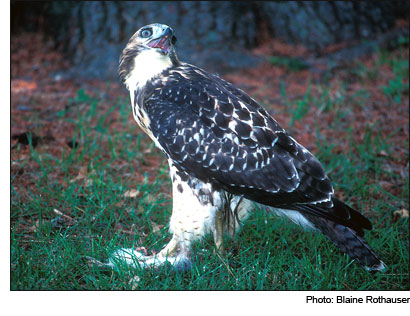
It was a black speck in the sky, gradually coming closer, and then I saw that it was a bird gliding gracefully, effortlessly, circling above me. It was a red-tailed hawk, the most common hawk in North America. Years of observation have shown that red-tailed hawks can easily mold themselves to any surrounding, but these birds prefer a habitat that is open. Hawks usually inhabit places like deserts and fields, perhaps to make it easier to find prey. They also like to have high-perching places nearby from which they can watch for prey.

Red-tails are known as very able hunters. They are widely reputed to have visual acuity several times that of a normal human being. In fact, hawks can see a mouse a half mile away. This is due to the many photoreceptors in the bird’s retina, an exceptional number of nerves connecting these receptors to the brain, and a small indented area of the retina which magnifies the central portion of the visual field. Hawks also see in color.

A fledgling hawk is fed by its parents until it leaves the nest for good. It will leave its parents’ nest as early as six weeks old. As the hawk grows older, it begins to act on its ancestral instinct to hunt for itself.

While other birds of prey like falcons use their mouths to kill their prey, red-tailed hawks both catch and kill prey with their claws, or talons. They also use their talons dismember a kill before swallowing it. A hawk’s preferred time for hunting is usually just before night fall, when daylight begins to lessen.

Even though red-tailed hawks are known as being a violent predator, this bird actually has a peaceful side. The hawk’s main mode of transportation is flight. When it flies, the hawk flaps its wings rapidly, and then uses that momentum to glide smoothly and gracefully through the air. Hawks typically move at 20 to 40 miles per hour.

Red-tails also are known for their unusual mating practices. The method this bird uses to reproduce is different from that of most other birds. The male and female will fly together up into the air in a circular motion. Once the two get to a certain height, the male will dive toward the female and then they will rise back to the height again. The two birds will repeat this until finally the male latches onto the female and they begin to free-fall down to earth.

Red-tailed hawks are monogamous and will keep the same mate their entire lives. In one year, a female hawk will lay about five eggs. Both the male and the female will watch the nest and take care of the eggs for about a month, until they hatch. Males and females also create their nests together, and will improve it together during mating season. One wonders if members of the hawk family may be mimicking some members of the human family.

A red-tailed hawk’s diet is very predictable, in that it includes a variety of small animals. However, most hawks are opportunistic feeders and they feed on anything they can catch. Some of these small animals may include snakes, lizards, mice, rabbits, squirrels, and any other type of small game that is found on the ground. More specifically, hawks like to eat smaller birds like doves, and bugs like grasshoppers and crickets.

The red-tailed hawk is protected under the Migratory Treaty Bird Act. This covers their residence in the United States, Canada, and Mexico. They do not have low population numbers at this point, but many people believe that without such protection their numbers would be low.

Hawks also provide us with a metaphor for our political life. When talking about politics, some people use the term “war hawk,” or simply “hawk” for short. This refers to someone favoring war in a debate over military action. “War hawks” are the opposite of “war doves.” The terms derive from the fact that hawks are predators which attack and feed on other animals, whereas doves mostly eat seeds and fruit, and are historically a symbol of peace.