Friday, April 5, 2013

Did You Know? About Wood Frogs

Wood frog (Rana sylvatica). Photo bu Blaine Rothauser.
Did you know that wood frogs (Rana sylvatica) are famous for their ability to survive the cold? That's right! This little hopper happily endures the freezing and thawing of its blood and tissues as it waits out the harshest North American winters.

How is this natural magic accomplished? Just before Jack Frost arrives, the wood frog collects an organic compound called urea inside its body. (Many different animals, including human beings, produce urea as part of their normal metabolic processes.) When those cold temperatures start setting in, the frog also starts to turn another substance, liver glycogen, into a simple sugar called glucose. The increased amounts of urea and glucose in the frog's body act just like an anti-freeze fluid—the official scientific term is "cryoprotectant"—limiting the number of ice crystals able to form in and around the frog's tissues and organs.

In fact, the anti-freeze works so well that healthy wood frogs may be able to survive a winter with as much as 65% of the water in their bodies frozen. That certainly is an important trick to know when you choose to hibernate just below the soil surface or beneath the leaf litter of a northern forest.

Wood frogs can be found as far south as Georgia in the eastern United States, and as far north as Canada's Labrador province. Their range stretches west through the Great lakes region, across Canada, and throughout most of Alaska. The wood frog is a native species here in our own Great Swamp.

Because the wood frog requires the existence of ephemeral wetlands, like the vernal pools at Great Swamp Watershed Association's Conservation Management Area, to survive and reproduce, it's important to make sure we preserve these special habitats from bulldozers and overdevelopment.

For more about wood frogs, see the following websites:
For kids:
Check out this video too!


(Article source: Wood Frogs. Wikipedia, http://en.wikipedia.org/wiki/Wood_frog)

Thursday, April 4, 2013

A Ribbit-ing Good Time!

Chorus frog (Pseudacris crucifer). Photo by Ari Kaufman, March 2013.
An extra week of warmer weather made all the difference at Great Swamp Watershed Association's annual Spring Peeper Party this past weekend. Originally scheduled for March 22, cooler temperatures and a late snow fall prompted us to push back the festivities until March 29, and we are so glad we waited!

Spring was definitely swinging by late afternoon on Friday when GSWA Board Member John Neale (Madison), and volunteers Steve Gruber (Long Hill Twp.) and Wes Boyce (Bernardsville) arrived to set up. The local peeper population sang with such exuberance that they could be heard above the noise of rush hour traffic on nearby I-287.

As dusk fell, naturalist-extraordinaire Blaine Rothauser (Florham Park), trekked our group of 21 intrepid kids and adults down the blue trail to the site of GSWA's bench memorial to local environmental legend Helen C. Fenske, the remarkable woman who led the charge to preserve Great Swamp from the kitchen of her home in Green Village. This also happens to be the site of one of the CMA's most active ephemeral wetlands, or vernal pools as they are more commonly known.

If you're scratching your head over all this terminology, you're not alone. Suffice it to say that an ephemeral wetland is little more than a body of water that exists for a short time after a rain fall or snow melt event. They are easy to overlook, but the crucial role they play as incubators for amphibians, insects, and even certain plants cannot be overstated. Without these shallow, unassuming depressions in the earth, our small corner of the planet might just become unrecognizable to us. Certainly our spring and summer nights would become all too silent.

Why? Because without our vernal pools all the chorus frogs, wood frogs, and other amphibians that fill the darkness with their comforting, familiar calls would simply disappear.

Our volunteers wasted no time showing our Peeper Partiers what is at stake. Moments after Blaine finished explaining vernal pool biology and its importance to local ecosystems, the team came back with a wood frog (Rana sylvatica) for everyone to inspect and admire. This was quickly followed up by a string of up-close-and-personal visits with a host of other amphibians, including a tiny chorus frog (Pseudacris crucifer) that graciously paused to pose for a photo before returning to important business under the water. That shot appears above, but for a larger version, as well as more photos from the evening, see the embedded slideshow below or visit GSWA's Flickr page.


If you were at the Spring Peeper Party, thank you for coming. We hope you enjoyed learning more about vernal pools and Great Swamp amphibians. If you couldn't make it this year, we hope you'll join us next year when we do it all again!

Monday, March 4, 2013

Wildlife And Water Health Feature In Upcoming Environmental Speakers Series


Great Swamp Watershed Association announces four events in its Spring 2013 Breakfast Briefing Series.

The Great Swamp Watershed Association (GSWA) is pleased to announce the schedule of speakers for its Spring 2013 Breakfast Briefing Series.  This season’s highlights will include an in-depth discussion of bats and bat conservation efforts, as well as a wide-ranging report on the cleanliness of water flowing through the Great Swamp and into the Passaic River.

On Tuesday, March 12, GSWA welcomes Jennifer Bohrman, lead biologist for bat research, education, and outreach at the Great Swamp National Wildlife Refuge.  Ms. Bohrman led a wild bat inventory and monitoring effort at the Refuge during the summer of 2012 and frequently presents to local communities on the topic of bat conservation.  In addition to offering some insight into the impact of the infamous White-nose Syndrome on bat populations in Great Swamp, she will provide some proven tips, techniques, and suggestions suitable for protecting bats in the back yard.

Tuesday, April 9, Dr. Meiyin Wu, Associate Professor of Biology and Molecular Biology and Director of the Passaic River Institute at Montclair State University, stops by to offer some perspective on water issues affecting communities downstream of the Great Swamp along the Passaic River.

Dr. Leland Pollock, Professor Emeritus of Biology at Drew University, visits on Tuesday, May 14.  For many years Dr. Pollock has studied macroinvertebrates—a catch-all term for bugs, worms, mollusks and other small, spineless creatures—living in the streams that feed Great Swamp.  Study findings from his annual survey of these wildlife populations adds to an understanding of long-term trends within the local environment and provides clues about the relative cleanliness of water passing through the Great Swamp region.  This event takes place at the Helen Whitney Case Auditorium at the Madison Public Library, 39 Keep Street, Madison, NJ.

On Tuesday, June 11, GSWA’s Director of Water Quality Programs Laura Kelm will present findings from the organization’s recent State of the Streams report on water conditions found throughout the Great Swamp Watershed region.  This extensive scientific research project engaged GSWA staff and volunteers in a year-long analysis of more than five years of chemical, visual, and biological water quality monitoring data taken from the watershed’s five major streams: the Upper Passaic River, Black Brook, Great Brook, Loantaka Brook, and Primrose Brook.  Results from the analysis will be used to establish historic trends for cleanliness of water flowing through local waterways; and help the organization identify emerging environmental conservation and restoration needs.

Most GSWA Breakfast Briefing events take place between 8:00 a.m. and 9:30 a.m. at the organization’s office located at 568 Tempe Wick Road in Morristown, NJ.  Alternate event locations are noted, if applicable.

GSWA created the Breakfast Briefing Series to help area residents stay informed about community environmental issues without taking valuable time away from work or family life.  Presentations are kept brief, focus on current environmental topics, and minimize overlap with most traditional business hours.

Coffee, tea, and a continental breakfast are always served free of charge

Advanced registration is requested. Please register online at www.GreatSwamp.org or by calling 973-538-3500 x22.

Monday, February 4, 2013

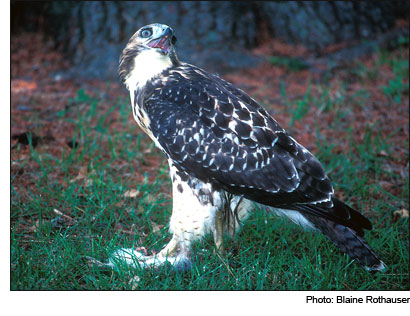
Did You Know? About Red-tailed Hawks

by Jim Northrop, GSWA Volunteer


It was a black speck in the sky, gradually coming closer, and then I saw that it was a bird gliding gracefully, effortlessly, circling above me. It was a red-tailed hawk, the most common hawk in North America. Years of observation have shown that red-tailed hawks can easily mold themselves to any surrounding, but these birds prefer a habitat that is open. Hawks usually inhabit places like deserts and fields, perhaps to make it easier to find prey. They also like to have high-perching places nearby from which they can watch for prey.

Red-tails are known as very able hunters. They are widely reputed to have visual acuity several times that of a normal human being. In fact, hawks can see a mouse a half mile away. This is due to the many photoreceptors in the bird’s retina, an exceptional number of nerves connecting these receptors to the brain, and a small indented area of the retina which magnifies the central portion of the visual field. Hawks also see in color.

A fledgling hawk is fed by its parents until it leaves the nest for good. It will leave its parents’ nest as early as six weeks old. As the hawk grows older, it begins to act on its ancestral instinct to hunt for itself.

While other birds of prey like falcons use their mouths to kill their prey, red-tailed hawks both catch and kill prey with their claws, or talons. They also use their talons dismember a kill before swallowing it. A hawk’s preferred time for hunting is usually just before night fall, when daylight begins to lessen.

Even though red-tailed hawks are known as being a violent predator, this bird actually has a peaceful side. The hawk’s main mode of transportation is flight. When it flies, the hawk flaps its wings rapidly, and then uses that momentum to glide smoothly and gracefully through the air. Hawks typically move at 20 to 40 miles per hour.

Red-tails also are known for their unusual mating practices. The method this bird uses to reproduce is different from that of most other birds. The male and female will fly together up into the air in a circular motion. Once the two get to a certain height, the male will dive toward the female and then they will rise back to the height again. The two birds will repeat this until finally the male latches onto the female and they begin to free-fall down to earth.

Red-tailed hawks are monogamous and will keep the same mate their entire lives. In one year, a female hawk will lay about five eggs. Both the male and the female will watch the nest and take care of the eggs for about a month, until they hatch. Males and females also create their nests together, and will improve it together during mating season. One wonders if members of the hawk family may be mimicking some members of the human family.

A red-tailed hawk’s diet is very predictable, in that it includes a variety of small animals. However, most hawks are opportunistic feeders and they feed on anything they can catch. Some of these small animals may include snakes, lizards, mice, rabbits, squirrels, and any other type of small game that is found on the ground. More specifically, hawks like to eat smaller birds like doves, and bugs like grasshoppers and crickets.

The red-tailed hawk is protected under the Migratory Treaty Bird Act. This covers their residence in the United States, Canada, and Mexico. They do not have low population numbers at this point, but many people believe that without such protection their numbers would be low.

Hawks also provide us with a metaphor for our political life. When talking about politics, some people use the term “war hawk,” or simply “hawk” for short. This refers to someone favoring war in a debate over military action. “War hawks” are the opposite of “war doves.” The terms derive from the fact that hawks are predators which attack and feed on other animals, whereas doves mostly eat seeds and fruit, and are historically a symbol of peace.

Friday, November 16, 2012

Rest and Be Thankful?


Sandytreefallvolunteerpost11162012
Okay, but consider volunteering at our Conservation Management Area (CMA) on the Sunday after Thanksgiving and the Great Swamp Watershed Association (GSWA) will be more thankful!

GSWA will hold a post-hurricane clean up and workday at its Conservation Management Area (CMA) on Sunday, November 25, 2012.

The workday will run 9:30 a.m.- 2:00 p.m.

The CMA is located at 1 Tiger Lily Lane in Harding, although many GPS systems place the location in Morristown.

There are tasks for all—from brush cleanup to moving chainsawed logs off the trail, to boardwalk repairs and fencing renovations—in the wake of Sandy's unwelcome redesign of the property.

We will have work gloves, simple tools, and snacks but if there are any chainsaw experts out there we could use their EXPERT help.

All those intersted in helping out are asked to email GSWA's Director of Outreach and Education Hazel England (hazele[at]greatswamp.org) with their availability.  Please provide some indication of the type of tasks you prefer—light-duty or heavy-duty. It's also helpful to let Hazel know how many other volunteers you plan to bring with you.

Anyone who has NOT volunteered for us in the past will need to read and sign a volunteer release form, so please RSVP if you are thinking about attending.

Coffee and donuts will be available starting at 9:00 a.m. 

This is your chance to get away from family after the long Thanksgiving holiday, or an opportunity to bring all those relatives together to work as a team to help recover and restore the public trails at the CMA.

Tuesday, October 16, 2012

Halloween Excitement in New Jersey’s Spooky Great Swamp

Come in costume or as you are to Great Swamp Watershed Association’s Spooky Swamp Walk, Oct. 26.

With Halloween right around the corner, is there a better time to visit a spooky swamp where owls hoot and coyotes cry?

On Friday, October 26, the Great Swamp Watershed Association (GSWA) will lead a series of Spooky Swamp Walks through its 53-acre Conservation Management Area (CMA) in Harding Township, NJ.

Come in costume or come as you are to this outdoor celebration of all things that go bump in the Great Swamp at night!

Little or big, all of the ghosts, ghouls, goblins, and witches who appear will be led on a special night-time tour of the darkest corners, eeriest boardwalks, and blackest recesses of GSWA’s own small corner of Great Swamp. Expect lots of fun and lots of surprises as you trek through forest and marsh after sunset.  If skies are clear, a near-full moon will light our way.

Costumes are encouraged! But, keep in mind that sturdy footwear and a jacket are recommended for this event. Families with children are encouraged to attend.  The hike is 1.4 miles long over level ground and the occasional boardwalk. Wet, muddy conditions are possible.

Walks begin at the CMA entrance located at 1 Tiger Lily Lane, Morristown, NJ.  Groups of 15 to 18 people will be led into the swamp every 15 minutes from 6:30 to 8:00 p.m. The last tour leaves at 8:00 p.m.  Cider, snacks, photo opportunities, Halloween music, and decorations will entertain those waiting to go on walks.  Wait times will vary based on event participation.

Advance registration is appreciated.  There is no fee for participation, however, voluntary donations to the Great Swamp Watershed Association are encouraged and may be made upon arrival. Please park cars along the cul-de-sac and along the sides of Tiger Lily Lane. More parking information will be made available at www.GreatSwamp.org as the event date approaches. No rain date.

To register, or for more information, visit www.GreatSwamp.org or call 973-538-3500 x22.


Tuesday, October 9, 2012

Great Swamp Watershed Association Announces Fall 2012 Breakfast Briefing Series

Mikeduffywqmeterwebbloglrg
Experts from NJ and beyond keep you up-to-date on local environmental issues while you are on the go.

The Great Swamp Watershed Association (GSWA) is pleased to announce speakers and presentations scheduled for its Fall 2012 Breakfast Briefing Series.  All events take place between 8:00 a.m. and 9:30 a.m. at GSWA’s office located at 568 Tempe Wick Road in Morristown, NJ.

On Tuesday, October 16, GSWA welcomes two guests for The Raritan & the Passaic: A Tale of Two Rivers, a special presentation that compares and contrasts these two important regional river systems.  Dr. Judy Shaw, senior research associate and director of the Sustainable Raritan River Initiative at Rutgers University’s Edward J. Bloustein School of Planning and Public Policy, will enumerate the myriad environmental issues these neighboring watersheds must address—especially the issue of flooding—as well as some environmental solutions residents of both regions can share.  Author Mary Bruno, whose book An American River: From Paradise to Superfund, Afloat on New Jersey’s Passaic was released this past May, will also be on hand to provide new perspectives on the Passaic River region.  Signed copies of Ms. Bruno’s book will be on sale throughout the event.

Tuesday, November 13, GSWA Director of Water Quality Programs Laura Kelm will discuss the overall health of the five major streams comprising the Great Swamp Watershed.  This State of the Streams report will summarize findings from a recent study of ten years of water testing data collected by Great Swamp Watershed Association, the former Ten Towns Committee, and others.

On Wednesday, December 5, Professor Joseph J. Seneca from Rutgers University’s Edward J. Bloustein School of Planning and Public Policy will present The Economic Implications of Climate Change In New Jersey.  Discussion will focus on how New Jersey might efficiently mitigate the economic effects of climate change through the reduction of greenhouse gas emissions, changes to public policy, and implementation of alternative energy strategies.

GSWA created the Breakfast Briefing Series to help area residents stay informed about community environmental issues without taking valuable time away from work or family life.  Presentations are kept brief, focus on current environmental topics, and minimize overlap with most traditional business hours. Coffee, tea, and a continental breakfast are always served free of charge.

Advance registration is requested. Please register by visiting www.GreatSwamp.org or by calling 973-538-3500 x22.

Photo: GSWA volunteer and citizen-scientist Mike Duffy captures water quality data from a tributary of the Upper Passaic River.